Black Hawk, the new world in which we had come to live, was a clean, well-planted little prairie town, with white fences and good green yards about the dwellings, wide, dusty streets, and shapely little trees growing along the wooden sidewalks. In the centre of town there were two rows of new brick ‘store’ buildings, a brick schoolhouse, the court-house, and four white churches. Our own house looked down over the town, and from our upstairs windows we could see the winding line of the river bluffs, two miles south of us. That river was to be my compensation for the lost freedom of the farming country.”
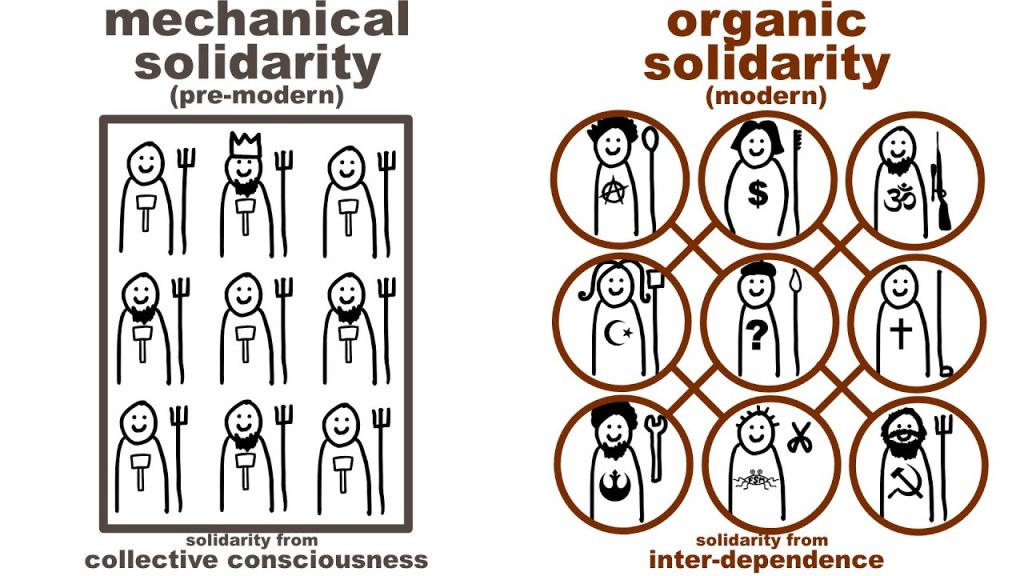
The narrative of My Antonia shows a duality between two types of lifestyles, as seen in Emile Durkheim’s concept of Solidarity. Solidarity exits in two ways — mechanical and organic. Mechanical Solidarity is in reference to pre-modern (or pre-industrialized) societies, similar to the life on the prairie. Individuals who live off the land find solidarity in their alikeness, otherwise known as collective consciousness. In a pre-modernized society, everyone shares similar ethics and views, as well as share similar jobs. On the prairie, for example, the Shimerdas are all farmers. Each of them have similar tasks that benefit the farm, and each of them find solidarity in the work they do to keep them afloat.
“The only two human beings of whom she spoke with any feeling were the Swede, Johnson, who had given her his claim, and Lena Lingard. She had persuaded Lena to come to San Francisco and go into business there.”
Organic Solidarity, however, refers to modern (or industrialized) societies, like those living in New York. Individuals who live in cities, for example, find solidarity within inter-dependence. In other words, every individual has their own purpose within the structure of their society, and society could be seen to function like an organism where everyone has a specialized job to keep society afloat. An example of Organic Solidarity within the novel could be seen in the life of Lena Lingard, who moves to San Francisco to open up a shop. The life on the prairie wasn’t exciting for Lena, so she decided to move West as it opened up room for opportunity.

With regards to Durkheim’s Solidarity, Antonia seems to characterize Mechanical Solidarity whereas Jim seems to characterize Organic Solidarity; Antonia remained on the farm her entire life, whereas Jim moved to the city to become a lawyer and to work on the railroad.
 Sociological Analysis of My Antonia